2025 CHRISTMAS HORROR SHORT STORY
CHALLENGE WINNER
Prize: £1,000
Finalists:
Jennifer Quail, Lily Bastock, Walden Stubbs, Alyson Osborn, Lisa Verdekal, Simon Clarke, Jo Kerr, Robert Burns, Mallory Owens, Marion Lougheed, Barlow Crassmont, Hannah Figgins, Katalin Abrudan, Morwenna Rogers, Kate H, Verdon Massy, Sophie Howard, Valerie Roberts, Jon Lea, E.H. Fairley, RA Colwall, Darren Murphy, Russell Mickler, Eliza Higgenbottom, Hannah Barclay, Marie Day, Maddie Logemann, Sally Tate, Charles Cline, Olivia Carla Smith, Deborah Sale-Butler, Raymond Brunell, Julia Knoef.
and the winner is…
Susan Wood
The Snow Baby
The days after Christmas, my Nana says, are chancy. The old year labours its last few breaths and the new one hasn’t yet come to term. Most years the weather takes a turn for the worse, bringing coughs and colds and lung infections. People see ghosts or hear the sirens sound from the disused pit. Chimneys smoke, cakes won’t rise, dogs raise their hackles when no one’s there. You have to get out of wet clothes quickly and always dry your hair. New Year’s Eve is for watching, sending out First Foots with coal and bread, doing what you can to shore up the luck because, on New Year’s Eve, the year is still on a knife edge.
Then, on New Year’s Day, we wake to find the next year has come while we were sleeping, established and solid already. The green tips of bulbs are poking through the snow in the rose bed, and we run between the houses while the dinner cooks. My Granda tells us to go down the alley to the gate and watch for a man coming down the road with as many noses on his face as days in the year. I watch for this amazing man but never see him and, instead, we cut the Christmas cake and the grown ups, who never otherwise drink, toast one another’s health with glasses of sherry.
I tell my counselor this in the run up to Christmas, the year I turn forty, a long run up, but the decorations are already going up in the shops, and tubs of Quality Street are easing out the last few pumpkins. I’ve been seeing the counselor for about six months. She isn’t the first but I prefer her to the others. She points out that I always talk about my childhood in the present tense and I say, I suppose I do, because in my head, it’s always happening.
The village where I grow up is on a snow line and the snow comes every year around New Year, rarely for Christmas, though we look for it every day. But, in 1969, it comes early. On Boxing Day morning we wake to snowlight and, before breakfast, we’re already in the yards making footprints, and the snow is heaped along the tops of the walls and filling the little patterns in the wrought iron gate.
Snow has settled in drifts against the outhouses. My uncle comes out in heavy boots with a shovel to clear it and fetch the coals. And, when he opens the coal house door, we see the baby.
At first, I think it’s a doll and it must be for Christmas, because there’s something waxy and unformed about its face. Then I think how cold it must be with snow drifted under the door right up to its feet. There’s a cover next to its body, like a bit of rusty towel, but its feet are bare and its skin is very white against the coal dust, as if its whole body was scooped in one piece out of white ice cream. It has eyelashes but no hair and the tiny hands are perfectly smooth and still. There’s a silence, like icicles, round the little body and, for a long minute, we stand in the silence and stare. Then my Granda steps up next to my uncle and stretches his arm across the doorframe, keeping my cousins back. And I know, without needing to be told, that this is something only adults should see. My uncle turns me around and pushes me towards the house, and I run through the porch into the back kitchen and fling myself onto my nana’s apron, pressing my face against the pocket that’s sticky and smells of gravy, and wrapping my arms tight round the tops of her legs. She prises me off and sits down in the chair, pulling me onto her knee, feet towards the fire, peeling off my wet coat, mittens, socks, and draping them over the fireguard. Steam rises off the wool and I watch the little bits of snow drop down onto the rug and turn to water, while the adults whisper over my head.
My Nana tells me a story about Snow Babies. How they appear on Christmas night, exactly on the first stroke of midnight. Beautiful and still, like little angels spun out of Christmas snow, as precious and as rare as a truly white Christmas. When the thaw comes, people say, they melt away, but sometimes, once in a hundred or two hundred years, a family finds a Snow Baby at midnight and brings it in to the hearth. And, if they warm it by the fire and give it a name, the Snow Baby breathes and opens up its eyes. And if they have it christened before New Year, it will grow up and become a mortal child, and that family will live, happy and blessed by God, forever.
I don’t believe us finding the Snow Baby is a real memory. Maybe my child's mind conjured it after I heard the story and I’m only remembering it now because of what happened. Memory is a chancy thing, after all. Maybe I dreamed it after I lost a baby. Because, if it was true, and I remembered something like that, then surely I should have remembered some kind of commotion, police coming to the house or an ambulance. Even in those days, if a child had been found, someone would have come around to ask questions. At one time, I was sure I could remember my cousin, Alice, asking to put candles outside the coal house and praying for the baby that had died, but when I asked her about it, she said it never happened.
I do see my cousins more since I lost the baby. For a long time, when we were growing up, it felt like I’d lost them. I went off to college and moved to London and they stayed in the village. When I fell pregnant and didn’t get married or move in with the father, that was a big thing. Those kinds of differences used to matter a lot, but they don’t anymore. My cousin Joe, bought the house next door to my Nana’s and is bringing his kids up there. It’s a family house again. And Alice got a nursing degree and became a midwife. She’s the one I can talk to about Leanne.
In my last session with the counselor, when I talk about this, she nods and smiles. We’re wrapping up and she wants to be sure there are people supporting me, people I can talk to. I tell her there are and it’s true. I’m in a better place at the end of this year than I was.
All the same, when I drive to my Nana’s house, I don’t tell anyone I’m coming. The snow has been forecast all week and on Christmas afternoon it starts to fall. By the time I get to the village, it’s snowing hard. I turn the headlights off at the top of the lane and drive slowly down the back alley to the turning point at the end. Then I heft my bags out of the car, lock up and walk back, with my hood up, to the back porch door.
In the yard, the snow is already over the tops of my shoes. Drifts are building slowly against the walls. The back door has sagged and the buckets and shovels in the porch are heaped with snow. I haven’t been in since the funeral but I have a key. Joe has the other one and I can see he’s made an effort at clearing up. There are no boots standing by the door, no aprons hanging over the fireguard.
I don’t want to put the light on but there are always candles in the kitchen drawer and my hand remembers where the matches are. Tomorrow, I mean to surprise my family with presents but, for now, I want to let them have Christmas night. I can see the tree lights in my cousin’s garden. Tomorrow, I’ll admire the kids’ toys and tell Joe and Julie I want to live in the house. I think they’ll be pleased I’ve decided not to sell. I pull the curtains across and light the kitchen fire, because the front room chimney needs sweeping and the fire in there always smokes. I boil the black kettle on the hearth, make a mug of tea, and fill a hot water bottle. Then I hang my blankets to warm on the fireguard and prop the shovel up against the door. I put my alarm clock in the centre of the mantlepiece.
My cousin’s houses are lovely, stripped back and modernized, but I know already that I don’t want to change this house. Drinking tea in the arm chair, I think that my Nana nursed my mother in this very same chair. It has wooden rockers and, when we were kids, we would pile into it all together and, if we threw all our weight against the back at once, it would rock right over and spill us into the pantry. Long shadows are dancing in the firelight on the kitchen walls and, in spite of myself, I start to feel warm and drowsy.
I sleep and dream about my Great Aunt Ella, the day the snow baby came. At tea time, I catch her alone in the pantry because I’ve been worrying all day about the story my Nana told. My Nana is soft and safe but my Auntie Ella is hard. They said, when her husband was ill once, he wanted a suit, and she said,
“Lets wait, Billy, see what the Doctor says.”
My Nana never forgave her for that. But sometimes, things happen and hard is what you need. I understand this, even as a child.
When Leanne died, they asked if I wanted to hold her. I’d been through labour knowing she was dead, that the birth would be a still birth, her funeral. A nurse held my hand all through that long afternoon and, when I said yes, the same nurse put her in my arms. Then they went out and gave us a moment together.
Leanne was wrapped in a towel and I unwrapped it and looked at the perfect body on my lap. Everything was just as it should be, except there was no breath. Each tiny finger had a perfect, shell-like nail. I pulled a blanket around us and told her her name. Then, after a while, they came back quietly and took her away. Her eyes never opened and I never knew what colour they were.
I ask my Auntie what happens if a snow baby doesn’t come to life. The thought of my family, not happy forever, not blessed by God, has been twisting up my stomach the whole day. I stand on one foot in the pantry, chewing my cheek with worry. For a minute she looks cross and as if she’s going to say something. Then she sighs and goes back to slicing the bread. After a while, she says,
“They carry on. That’s all they can do. That’s all a person can ever do in this world.’’
I realise I’m dreaming in my Nana’s kitchen. I dream a baby is crying with desperate urgency in the dark. The crying seems to be endless and far away. At first it seems to be nothing to do with me, and then I jerk awake and feel my hands on the wooden arms of the chair. The candle has burned down and the fire is cold in the grate. I don’t know why the alarm clock didn’t wake me. When I stand up, my feet are numb with cold. I lurch, feeling my way, blind, to the back porch door. Outside the wind has dropped and the yard is full of a dreadful silence. The snow makes strange shapes against the walls. I can see the outline of the outhouses and the drifts of snow against them. The stars are as cold and hard as ice chips in an infinite sky.
In the starlight, I can tell that the coal house door is standing a little ajar. I walk towards it slowly, across the yard, and stand, for a long minute, saying a prayer. Then I take hold of the handle and pull it open.
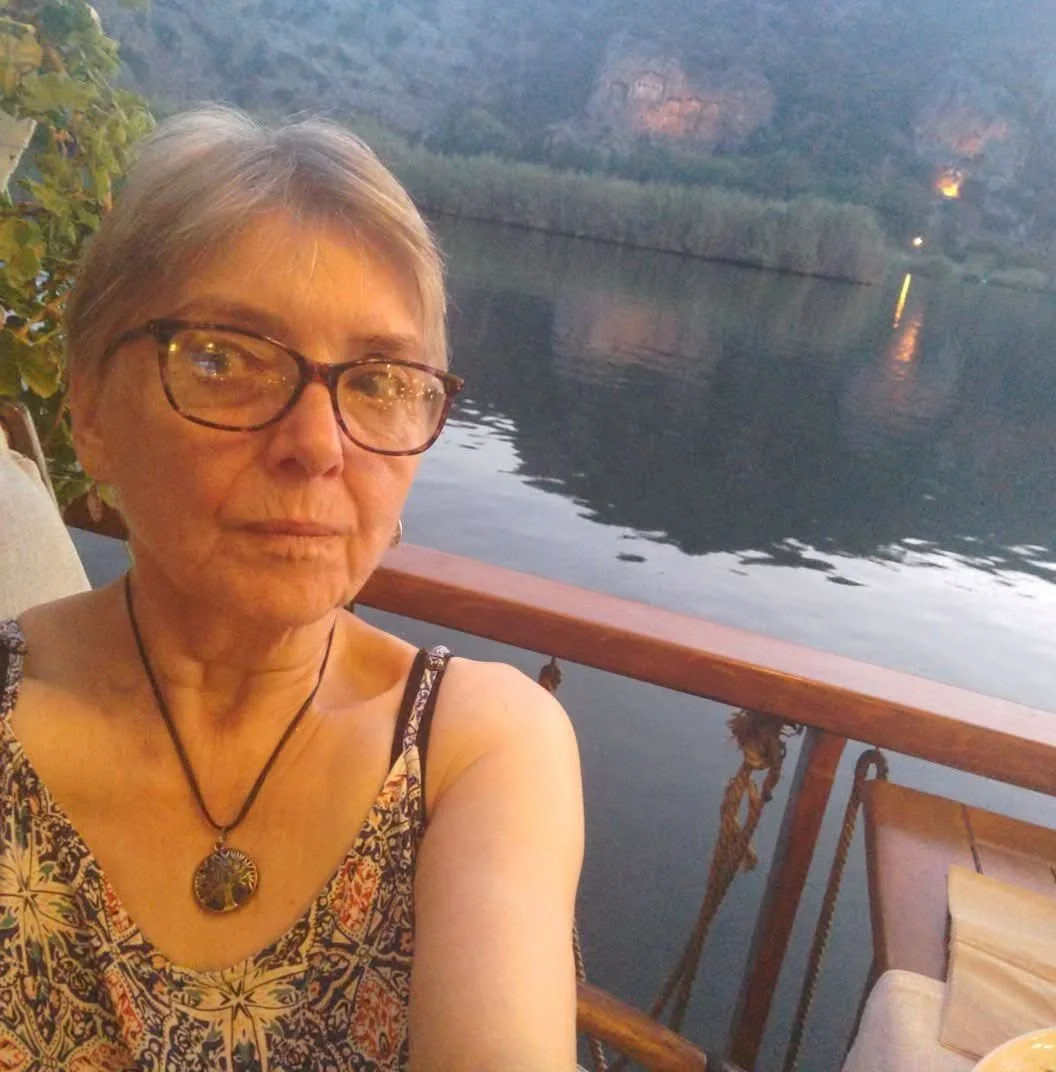
About our winner…
Susan Wood is an enthusiastic writer who is much better at starting things than finishing them. She works as an administrator for Quakers in the North East of England and is passionate about American roots music, cats, nature, the North East, and, above all, stories. She’s unable to name a genre she doesn’t read.