2025 OPEN SHORT STORY COMPETITION SECOND PLACE
Second place goes to…
E.A. Oman
THE KNUCKLEBONE
Cal
“But why would you build anything here? “ I saw that she was really asking, affably outraged by the easy route to disaster the site gave. Suzanne jerked a hand toward the mountains, a humid and soundless surround, the plunging haphazard ravine behind at the spectacular nose of the parabola- a hairpin turn right in front of the “Knuckle”- my place.
“It’s the land I had, “ I said. “ I didn’t have another place. They gave us this as part of the Next Generation reparations deal in the eighties. It’s nine and a half acres.”
“Reparations for what, like the Trail of Tears?”
“No, not directly. Different tribe. There were a lot of different phases and initiatives from the Bureau of Indian affairs to make up for what had happened. And for taking the Indian kids from their homes and sending them to boarding school. But this was a local initiative, just for the Aracoma tribe.”
She didn’t say all the things that could be said about the dilemma of the site, brimming with hazards so visible it was like selling someone property next to a raging river that foamed up the side of the house even as you toured the premises. She also didn’t start any of the ready speeches that could be made about ethnic justice, or versions of the old bitter story about one group with power taking everything from another without it. She had a certain canny silence at times that reminded me of Litz, but with Lanie’s, and Finn’s pointed chin.
Instead of commenting, she walked the site. 70 feet back to the drop-off, 157 feet from side to side, scuffing her Cowboy boots on the gravel. A shallow pool of violets and buttercups fringed the rim. She put her hand against the thin locust tree that leaned toward the gorge. She peered into it, seeing no skeleton of either the two trucks or the motorcycle that had plunged into it many years back, but only sumac and goldenrod and the outline of rocks blurred by branches and Queen Anne’s lace, fuzzy now in the sun.
“There’s nothing left down there now,” I said. “Well, we put his ashes all around here, so that’s not really true.” I stayed silent for a minute.
“I don’t know what Kate told you, but I think Finn was so happy-“ I laughed. “I mean, he was always happy, but he was probably amazed, maybe a little overwhelmed when she told him she was expecting. He was young but he would have been just crazy about you.”
She just nodded and walked over to the old shipping container we had used to expand the kitchen area and hammered lightly on it with the heel of her hand, raising a dull echo. Not angry, just kinetic. There was a shade of the family violence- a radiant impatience- behind the emphasis of her gestures that came across as an athletic readiness and low burn of joy. So much like Finn.
A grey SUV took the turn very slowly, flashing brakes until halfway up the other side of the turn, the driver tensed over the wheel.
“Its just the riskiest site?’ Her voice was wondering and solemn, but her face was always on the edge of mischief. She was not exactly as expected- a hectic mixture of sturdy and uncertain, imperious and questioning. A formidable, changeable girl, like her mother. You could also track the native line- partly mine- in her jaw and cheekbones.
“When I was 25, that’s exactly what I liked about it,” I said.
There was a scatter of Red Bull cans and cigarette butts, which she was nudging idly with the toe of her boot, half challenging me and half ready to be generously entertained. People had taken good enough care of her that she had that open, flexible quality. Only there was still an occasional flicker of the narrow Appalachian hunger underneath the dozy California negligence. The care showed in the array of self-pleasing bracelets on her hands, gold and yarn side by side, and by the easy regal air with which she surveyed the deceptively mild remnants of the place that had first created and then wrecked everything. But Litz, now happy and settled at last with Jenny, had finally reached into this shared dreadful past and plucked out the astonishing gift of this girl.
“My friend Sam was investing with me, “ I continued. “He inherited the family funeral business in town but of course that depressed the hell out of him. He always had schemes about a roadhouse.” Sam’s dream had been to build a 45 foot ketch that would pry him from these humid mountains and set him on the open sea, but instead we built the Knuckle.
“Cool if you could get bands also, “ she said.
“Yeah, we did. We got a few bands. Finn was like a roadie with those guys, helping them set up. He was trying to learn the drums.”
We walked around the back that bordered the gorge, to enter the storage rooms from the rear. Above one room was a narrow crawl space like the berth on a ship with a thin mattress, now twisted as if in the process or turning over. There was a blue and green flannel shirt that could once have been Finn’s heaped in the back corner.
“Any customer too drunk to get home, we used to put up there.”
She laughed.
“Nice”
We continued past the long arm of the freezer door and the other storage rooms that gave off a dank sweetness of old sponges. The door swung out into the Knuckle’s main bar and dining-room; one long rectangle held the bar and a narrow line of two-tops, flanked by a railing. Three steps down, another squarish area had eight or nine more round tables and a Hurlitzer, still with its gold lettering and shining record edges intact, still with its curved glass front unbroken.
We sat at one of the tables. She absently stroked the names scratched into the wood.
I gestured behind her, toward the road. “The thing is, with the fourteen percent grade of the road on both sides, you really can’t take that turn safely at more than about ten miles an hour- most interstates considered steep are only six percent. Anyway people misjudge and then have to take it wider and skid into the parking lot.”
“But The Knuckle isn’t that far back from the road.”
“Exactly. I know. Not nearly far enough, so it’s always like living in a risk zone. Going down is the worst. Every time you hear the sound of the air brakes from the road, you wonder if the truck will make the turn, or jackknife from the torque”
She laughed.
“And that’s what you liked about it. Were you hooked on the fear?”I smiled.
“Well, it should have been fear. I genuinely believed someone would plow into it. When it was busy and loud, I couldn’t always hear the truck brakes so any minute it could happen.” I gestured to the wall, “I could imagine the grill of a semi coming through there like it was paper. It used to give me this strange drowsy feeling like there was nothing I could do- it might be just about to happen- or maybe now- or now…”
“Ok, so you’re crazy.” She was happy. “What did you guys serve?
“Sushi and pho.” She raised her eyebrows. I laughed. “ What do you think we served? Burgers, fries and a salad with one slice of tomato and one slice of onion. Roadhouse stuff. Nothing fringy- oh except when Lanie went through a middle -eastern phase and made her own hummus. Was not a big seller.”
We hadn’t mentioned her until now. The front window was dim with dust, but sun came in from the parking lot side and made the lighter browns gleam in her dark hair. She ran her finger along Cliff’s name in the wood.
“So was she that kind of person- who was always trying something new?”
“Yeah, that’s fair. I’m sure she still is.” I rubbed my eyes, then my whole face.
“She did not like to let the grass grow under her feet, unless she was taking care of your Dad. That was enough for her“ Life used to be so quick and bright, I thought. I didn’t even know if I could handle that pace anymore, all the faces and talk and love.
“I was always more the one tied to the area,” I said.
I looked around at the tables, bar, railings- all just pieces of straight wood at different angles that had once coalesced into an actual place. It was shabby now, with only Carla and Jim left of the old crew.
My granddaughter’s lovely seventeen -year old face, framed by errant tawny wisps of hair, reflected curiosity and a sweet, unforced understanding that looked so much like Finn that my chest seized and loosened at the same time.
Lanie
I came back to the Knuckle because I hated it and because we recognized each other.
So, of all the questions people ask and answer, I think the most telling one is “Where?” Like all the itching questions, “where” is what the ancient brain remembers because it is about survival, the suitability of the terrain, its tumbling slopes and coves and whether they are safe, or treacherous. Is the water spilling down from the glacier? Where are the enemies hiding? Where does the family gather?
In modern times comes the question about that place’s delicate stand-off with each person who lives there and how their responses to the hazards around them binds with personality- or carves into it. Some people are natives on a deeper level than the rest of us, in sync in their bones, thoughtlessly suited to the winds or water or social media around them. My son was at home in the world- in his very bones. Other people struggle and compromise to make it, some mis-match of their genes making everything harder to figure out. We are really asking: where can I be the most powerful? Where can I rule? I have struggled in my skin to know this, to understand how I step from zones of dominance to frailty. I thought at some point I might stumble into a place where I would be recognized as its perfect creature. I have had moments of being the perfect creature in its zone, and if I am being scorchingly honest- at those moments I still felt around for an edge of discomfort, to rock the balance.
The tribes used to know all about the demands of place. In grade school , with the freckled grandchildren of the men who threw us off the land during westward expansion, I learned to match the tribes with the type of house, type of food source, type of weapon. Northeastern tribes had longhouses for bad weather, hunting traps, furs. Inuits had hollowed -out pine canoes, waterproofed with resin, dried fish. It all matches up. Except we are displaced and dispersed so some of our old skills don’t translate. The narrow Ethiopian engineer drives an Uber in Fargo and some gorgeous massive husky who would have been king of all the sled dogs, pants outside a Popeye’s in the Georgia heat.
Even those of us rich enough to choose- I chose Vancouver for the sight of topheavy container ships sitting on the ocean west of Stanley park ferrying goods from Asia and because it was a place that held absolutely no personal menace for me- even we don’t always pick the places we are built for, where we could be Queen because the pain of their relevance and of the loved faces that surround us there. But I learned at last that being happy turns out to be a lesser thing than being in your place and being Queen.
So after seventeen years of being away, and fitting nowhere, I came back to the Knuckle to meet the granddaughter I never knew I had.
The short version is that The Knucklebone is a ramshackle roadhouse in Southern West Virginia that Cal and I built partly using oakwood from a burned boat frame on an irregular wedge of property the government gave him as part of a local Indian reparations deal. Nine acres of scrub at the apex of a hairpin turn. Really a joke of a site. The back of the lot plunged into a deep ravine of scrub oak, spruce and goldenrod and the right side- standing with your back to the road- climbed up the rocky top half of another mountain.
I laughed when I first saw it and Cal just said “no fucking way” because it was just like the old days when tribes were moved from lush premium valleys into the badlands of North Dakota. The lot, measuring about 70 feet deep and 150 wide, was level and treeless, so we wouldn’t have to spend a fortune to clear the land anyway.
Something about the unsuitability of the site called to me. The set-up was just so risky- the nightmare end point for all the momentum of trucks rushing down the hill- from either side, both sides. If they passed exactly at the nose of the turn, airbrakes moaning, it was like two bulls coming at each other in a narrow alley. The geographical risk came from the weird distinction of having two steep grades coming down into a V, the place named for the jut of the knuckle when you make a fist, but really more like the deep V between the thumb and first finger when you open your hand. Every single time a car or truck took the turn you could feel the stress of braking, the torque it took not to plow straight ahead and over the edge filling the air with excitement. It’s what I liked about it. It was like the promise of travel without moving.
All the near crashes seemed to jazz up the place with potential energy and made the locals livelier than they usually were. That was the theory. The food was nothing special. We were just serving beer and burgers in a corner of the world the economy forgot, but it could have been in a hammock hanging between peaks of the Andes because something could always go wrong. A few times it did, and when the last, most dreaded thing ended it all, it sent me spiraling away, like a torn paper scrap in a storm.
Saturday night was always crazy at the Knuckle, crazy with people coming from the sparse counties around, draining into the mad hollow from the steep hills like rainwater. People letting the warped screen doors, for years not flush with their frames, softly slam as they pulled a flannel shirt from the laundry, sniffed it, put it on. They walked by vegetable gardens where the green bean runners grew, past the friendly bulk of rusting car chassis and cans and loose laundry lines strung to the old oak, everything painted with late sun a few hours ago but now dark and the need for company and fun becoming an insistent itch in the chest.
In crooked trailers almost reclaimed as part of the land, citizens of this bleak and wild county stood with empty eyes under showers where rust and lime blocked half the spray holes, men and women who longed for someone and the Knuckle sat generously at the bottom of two mountains collecting whoever slid down from them like sand into an open palm. On a regular Saturday night there were dozens and dozens crowded in the dining room and dozens more a few steps up at the bar leaning in with a handful of bills to get Tammy or Cal’s attention. The Knuckle had a bald simple front with no porch and large paned windows on either side of the door.
People stood around smoking in the dirt lot around the side and in the back, leaning against the shipping container Cal had added for additional storage. Clients who were too drunk to pretend they could drive spent the night in the container’s narrow berth, like stowaways on a ship. By the time Finn was 20 they sometimes found that he had crashed there after helping the crew on the late shift; he was the denizen and genie of the place. He was its pet cat, a heckler of bands and a worker to count on, dodging into the back to grab buns from the fridge, drawing a beer, underage, tilting it to shed the foam while Jim was in the bathroom. He was in the right place, in a way that hardly ever comes to people, his sinewy build still angular and always on the move. Part of the draw of the place beyond its deadly hairpin turn energies, was the light coming off this boy, from his trash talk and bouncy walk to his wondrous recollection of names and faces of the clientele.
Cal’s place up and around the hill, physically removed by roughly 50 absolute yards from the back of the bar, was a world apart. The thickness and tangled mass of the woods and a steep elevation hid the house completely from view. It faced the curving gorge and violet hills behind. The house itself had no point of reference with anything around and no familial link to the water-stained farmhouses or trailers or frame bungalows pitched in a line between the mountains and road in the string of small towns that wound through the valleys. You could not even hear the Knuckle from there. As a result of both their visions, and Lanie’s erratic passions, his house felt borrowed from a refurbished loft development project in Seattle, faintly Asiatic and clean of local history. The front was a silvery plane of teak with a long unbroken rectangular window above and a crenellated metal roof. There was a tangle of daisies and queen Anne’s lace in a blue tin pot next to the door and the door itself was a sliding barn door Cal and found, dragged and set into the front many years before they were considered cool. The place looked toward a sloping meadow of tall grasses that could have been anywhere. The Knuckle was a perplexing scarecrow of a place, but this house behind felt as deviant and singular as the intelligence Cal lodged behind the persona of roadhouse proprietor.
Invisible from the main road, eccentrically assembled, strangely accessed by an overgrown path and sacredly apart- it was Cal’s refuge from everything and reflected the wild loneliness and the deep shapeshifting force of his pain and solitude. Inside, the design was a spiral of gradual layers, each room a few shallow steps up. Walking in, you walked a spiral, coming first into a smell of cedar and bacon and a few midcentury-style pieces, chairs and pillows of bright Bohemian color, all overlaid with male negligence and improvisation. A square table with papers and keys filled the entrance, with a big closet to the right. two steps up to the left the living-room, dominated by a strikingly large sofa of deep persimmon, a teak sideboard and a stone fireplace; two more steps up to an all-purpose room, a long scarred pine table flanked by soft chairs with indian fabrics and rose and sea green and tangerine pillows. Bookshelves with the books stashed upright and sideways and in slumping diagonals.
Most of the windows looked out to the back of the mountain. Two more steps up to the kitchen with benches in the corner that stashed all the lightbulbs, paper towels, emergency flashlights and other supplies. The kitchen had the dented tin counters of a diner and green wooden cabinets that now held only pasta and some soup. The fridge was standard and white, filled mainly with beer, orange juice and some ambitious exotic condiments like cocktail onions and tamarind paste from a long time before. The kitchen showed the gradual loss of hope more starkly than the other rooms, but it was in the other rooms too.
Behind the kitchen was a pantry sparsely stocked with paper towels- it was under the staircase-almost as steep as a ladder- which led up to the open loft that had been their bedroom. The back wall of the pantry was also the door to a small bathroom, and another door led to Finn’s room. Upstairs in the bedroom it was two steps down to the large bed still covered with the light green duvet splashed in red poppies, still so pretty in spite of associations with heroin or Flander’s Field or Lanie’s departure and various other kinds of anguish.
Among other things, Litz issued the liquor and gaming licenses for the county. He exercised a great but narrow power with straightforward greed and acumen, and dealt affably with the network of tribes that owned the casinos. One of the quirks of Litz’s office was the softly fluttering prayer flags strung diagonally across the far corner from bookcase to bookcase, one of which held business honors from the local community and photos of his niece at different ages. The lineage at play in the sweet features of her face told a secret he still held close. The flicker of bright red or green from the flags evoked in him an echo of past joy, the triangles of color like the ones fluttering over his uncle’s used car dealership where he had worked his senior year of high school.
His father’s accountant Cheryl had occupied a tidy utilitarian office off the main floor, where she dressed better than the job warranted and sat gracefully with her feet flexed in her tan heels as she leaned toward the keyboard. Her daughter Lanie came by on her bike sometimes after school to help Litz spray the vinyl down in the recently purchased cars, or hand him tools while he replaced headlights and taillights. She was a lovely silky girl with a steady nature and tan, poreless skin that gleamed after the bike ride. She wore her very long dark hair in a high ponytail that swished like a horse’s tail and smelled like coconut.
When the shop was shut in the evening they would lie down together on the long back seats of the Chevy Eldorados or Ford Galaxies, screened from the road by a 1960 land rover displayed on a ramp and by a fortress of other vintage vehicles. The raised ridges of her collarbones , the wispy new hair on her forehead and the sudden leap of thigh muscles under his palm all struck him as magical, the most real and least real thing he had ever experienced. It was an exalted zone where he could never figure out how much time had passed. The halogen security lights lit up the rim of the steering wheel and bats flew outside of their glare like ragged umbrellas. Delighted by something he said, she sometimes laughed beneath him and he felt the ripples against his own stomach and in his blood, hard to distinguish from the happiness humming through him already. Those hushed, carnal hours, giddy and honest, seemed electric with a conviction of his own maleness; he tried to speak through her hair while her body threw off heat against him. The unquestioning deep cooperation of their bodies together was the literal shape heaven took in his mind after that.
After High School some of them scattered to different colleges, but by then she had already been with Cal for months. The imprint of her loss attached to an image in the stadium, a moment where she had raised her head as Cal hopped over to the bench on his uninjured leg after getting hammered by the Jayhawk defense. His coal black hair and pirate grin flashing under the stadium lights. It wasn’t necessarily the moment she fell for him, but Litz’s memory had invested the slow raising of Lanie’s chin and focused appraisal of his rival with the status of legend; that was the sudden strike when she had fallen for Cal and the rest was just the stuttering and terrible execution of the decision. In a small town, there were few choices and the matches made early drifted into kids and middle age so fast; he felt his future snuffed out. It still gutted him to remember the sweet but uncomprehending gaze Lanie turned on him when he had afterwards offered her his jacket, or a coke, her mind already at play in a faraway field.
Lanie
In provisional life you stay busy, although nothing will ever move again. The sun is fuzzy on my eyes and the rumble of the big bumblebees on the deck un-menacing. The mourning doves seem so soft and peaceful, but fly strangely close to my face so I can hear the air ruffle. I wonder about the gradations of suffering- does a 400 degree fire feel worse than a 350 degree one to the burn victim?- certainly the mind understands when something brings even the slightest relief. When you march your body into the future but leave your child behind, it is very hard, almost un-negotiable, having to care for yourself. I was eating well now, beautifully even, in the stubborn way women teach themselves to live correctly. I had been through the hollow years of being almost literally beside myself, not swallowing, making thin cuts in my arms, taking sedatives to cancel my mind.
I fled to many places, among them Vancouver, New Orleans and Boulder- all places unknown to me, where my life would be less relevant- and I perched there until I started to have routines and my life found pockets of warmth and then I would run again from the sick reality that I could be experiencing these days of meaning when my son wasn’t. I have never had to grasp anything as expansive or unreal as the idea that he was not elsewhere in the vast world, at some table laughing and greeting people with antic humor, that his particular color was gone from the world’s palette. When you miss your child you miss him not just at the last version, but at all the different ages and the ones that will never come.
Santa Fe was an eating phase for me, after a year in Maryland of hardly swallowing and sucking blended drinks through a straw, and putting the drinks down on a shelf or the top of a seldom- used table and finding them weeks and months later. There turned out to be a wide range of things that could happen to abandoned drinks- some just simply evaporated, some left a scabbed line, some festered and crusted and some formed a lava shell that took the whole glass with it, a hardened judging object that had to be tossed.
I tossed many clothes and objects the first few years. Seeing a dress from a hopeful era as a young mother was like a garish parade smashed into my face, and gave me a spasm of self-loathing at what I had ruined. I know I didn’t do it. I know I did nothing but grieve because my son skidded at high speed and plunged over the lip of the valley and into the arms of a tree. It held him, his neck broken, while the bike smashed down through the 90 feet of layered branches and scrub to rest like a sculpture on the valley floor below. My defined role was just to feel pain. But I ended up feeling other exquisitely bad corollaries to grief, like a sick idea that I had taken the place in the living world reserved for him, stolen his ticket. Telling myself that I had been alive before he had been alive, and assembled him myself in my body, and looked after him with devotion and even exuberance did nothing to lift the sense that I had stolen his chance. I left Cal to give up even more, renounce all potential solace. It was this mean and scrappy self- that used trickery and selfishness to keep living- that came after the paper self that never ate or swallowed. This hungrily hating self was the one I began to feed.
I moved to Santa Fe, rented an adobe styled in-law house at the far end of a fenced scrubby yard. Our back fence bordered the dirt parking lot of a vast plant nursery that sold colorful Mexican tiles, outdoor planters and hanging ceramic suns waving fat wavy rays. Rows and rows of huge ceramic pots, the soft and lingering jade that made my jaw ache, next the dusty blue, the inky indigo, butter yellow, each so beautiful it wasn’t safe for me to drink them in too much. Young native- American boys- with Cal’s straight black hair- helped people load bags of mulch and small trees into the backs of their pick-up trucks. I had never been here before and it had no specific references for me, but the sweetness of those boys and rapture of the colors was a risk for my equilibrium.
I waitressed at a fancy taqueria named “Casita” a few lots behind the Georgia O’Keefe museum, its door and outside spaces strung with fairy lights all year round, terraced with wooden decks on each side. People often spoke to me in Spanish, since the shades of brown in my hair, eyes and skin can be interpreted that way. I enjoyed the physical task of bringing plates and the heat of the plates ranged down my forearm. I liked the local couple who owned the place, the repetitions of the menu, the easy childlike moods of tourists and the drape and sway of all the lights overhead.
Only sometimes, cleaning up and wiping down tables, corralling the cactus-shaped salts and peppers and cholula sauce back to their place, did I feel a gust of memory of the Knucklebone and the late nights restoring order to the wooden tables, sweeping up French fries, emptying beer bottles into the sink. Some band members might still be loitering over a last beer or smoking around the side. Finn would be there last, always extra awake during the night, dragging the tables back that had been moved, or unplugging amps. He moved like an athlete in the sense that he would take some action, but also accomplish something else along the way- it’s hard to describe. He wiped under a ketchup bottle, kicked a chair into place, shouted a comment to the bartender; as a child, even, he had always had that readiness and economy of movement, was always doing more than one thing, so easily. He lived easily, since he was deeply at home with other people, in his body, and most of all in the Knuckle. Restless physically sometimes, ready to pounce with energy, but always lightly balanced, curious, just happy in his mind.
The desert cold came in the back of the Casita kitchen and was so different from the sweaty pressing palm of West Virginia humidity that it couldn’t have seemed further away. The low humidity gave me the perfect place to shed memories; the air seemed too thin for moods, as indifferent as space. I felt hollow and scoured. The other workers knew me as Lena, which was close enough.After my shift, on nights I felt heckled from inside, I started eating the paper -thin house-made tortilla chips with other staff, dusted with crystals of salt and tangy with lime. Stacked near the sink were halves of the large squares of flan striped with a berry sauce, some left almost pristine by families and I could eat them in a few creamy bites, almost a brief inhale without chewing. Time also became tame and creamy. I was talented at eating an extreme amount without broadcasting it, within the normal scope of my clean-up and gestures. I ate untouched soft tacos in a few bites, holding part of the leaking cylinder still in my mouth so as not to chew the shredded chicken and cilantro while passing the other employees. Leftover tortillas and beans I put in a zip-lock and later ate them at home after microwaving them with more shredded cheese. I built large spoonfuls of sour cream into peaks, envisioning, in the numb illogic of a binge, the comforts of Heidi in the alps with her grandfather’s dairy cows. I made hot chocolate with cayenne and cream, melted and velvety in the throat. I never made two, but I felt dimly a child sipping opposite me.
The chewing- it’s an animal thing- you can’t explain it. It’s being in the grip of something. I was trying to fill up- really to capacity, so that I could round out those bleak corners. There was something I was trying to reach, that could not be reached, in the far corners. Then later, when I passed into joyless finishing, jaws like a metronome and my mind turned off, passing into sickness, throwing it all up- then it became about cleaning the darkness from those same corners. It was like swirling water into a pan and dumping it out to clean it and it came with a dogged sense of routine maintenance, even of discipline. For a moment some pain would leave with the food. I often went for days eating small amounts of healthy food but again the tension would build. The drive to fill and unfill, fill and unfill, gave me some kind of baseline machine activity that sequestered emotion.
There was a judge, behind my eyes, who noted that all this turbulent theater of eating and un-eating could never shift any deep truths about what was real. It didn’t matter at all- the judge didn’t care about the creature or the creature about the judge and they coexisted in weariness and contempt. It was another drab way to mark time. The flurry of food procurement, of paying for the family size flaming -hot Cheetos, which turned your fingers into stumps of flame, or buying quarts and half gallons of Mint chocolate chip and coffee ice cream from the enchantingly sweet pockmarked teenager on the night shift at the Shell mini-mart- this flurry barely echoed in the deep silence around me and inside me. It was what it was- a hectic scrabbling that meant no more than the diagonal swish of a snake did to the ticking time of the desert.
Some of the vendors on the town square, I knew to talk to; they had their jewelry or small carvings arrayed on the tribal blankets spread in front of them. They sat in chairs under the long bluish shadows of the arcade. The dry breeze could lead one to discount the blank brightness of the desert sun. It parched colors and liquid and even straight thinking if you baked under it for too long.
A few weeks ago, I bought a post card of the Basilica of St. Francis, its giant cedar sharp against a fiercely blue sky. I wrote “still putting one foot in front of the other, under this crazy sky. No roots. Xo” I signed it “L”. I still loved him, but he was an accomplice and a witness on the road to ruin.
“Do you live here, or just visiting,” asked a man drinking at the bar at the Governer’s Inn, one lavender evening in early September.
“Just visiting everywhere,” I said. He could have been the usual guy I meet, laughing early at whatever response passed for repartee. There were intervals which could be filled with almost any statement, in any language, as long as the rhythm of exchange was observed, and you laughed; but every so often someone actually listens.
“Why would you say that? Do you travel a lot?”
“It’s hard to describe.” I took a sip of my gin and tonic, barely getting my lips wet. “I’ve actually lived here almost three years”
“But it’s not home”
“No”
“So it’s a way station on the way to someplace else? Where are you heading?" He lifted his drink in a half-toast toward me. “Sorry to be so curious. You don’t have to tell me anything.” I shrugged.
“It’s fine. It is a stop on the way to someplace else, I’m just not sure where I’m going next.”
“The Chinese have a saying ‘the person next to you is carrying a terrible burden,’” he said. “and it’s always true.” There was an interval and I mildly regret that I never asked about his burden.
I heard the ice clink as he tilted his drink to finish it. I never usually want to talk about the real things ever again or open the door to where the past sits, removed and unfixable as a stone idol. But all at once I felt a hot chime of panic to tell how it was. I swallowed,
“I’m looking for someone”
“I’m sorry. That’s hard. It sounds serious.” He sat very still with his wrists between his knees. “Is it one of your kids?”
“Yes. It is, it’s my son, but” And I could feel the truth leaping into my throat and my eyes, my words rushed, “ but he died, his name was Finn, he died years ago. He went over a cliff on a motorcycle. So I know I won’t find him, I’m not crazy, I know he’s not anywhere. He’s back in West Virginia.” He nodded and handed me a cocktail napkin for my eyes. “We sprinkled his ashes around the road house because he always loved it. Our roadhouse was called the Knuckle.” I felt an incredulous buoyancy in my head, luxurious as a murderer soaking in the dark bath of confession. I told him about the bar, the shipping container, the hairpin turn and the cliff ahead. The tree I loved, that caught him in her branches. I told him about Cal and the ugly wrangling with Litz over the liquor license. The sweet girl Kate, Litz’s niece, who Finn had been so wild about and who moved to California soon after, with her Mom.. The bottles and dark wood of the bar had become like the profound unchanging set of a play behind me, as I talked and talked. The man remained quietly listening- for hours?- only stopping twice to say “I’m Derek, by the way” and then to order a beer.
When I wound down at last we sat for minutes in silence. He finally clinked my glass with his and said,
“Here’s to your travels. Not to sound too oracular, but most journeys end up being a circle. You'll probably need to go back.”
Cal showed up three weeks later as if summoned, walking among the blue shadows of the arcade, a gaunter version of his face smiling, inky hair touched with gray, wistful, quizzical, happy, brandishing on his phone the photos of the magical girl that the fierce torrents of life had swept back down to us at The Knucklebone.
About our winner…
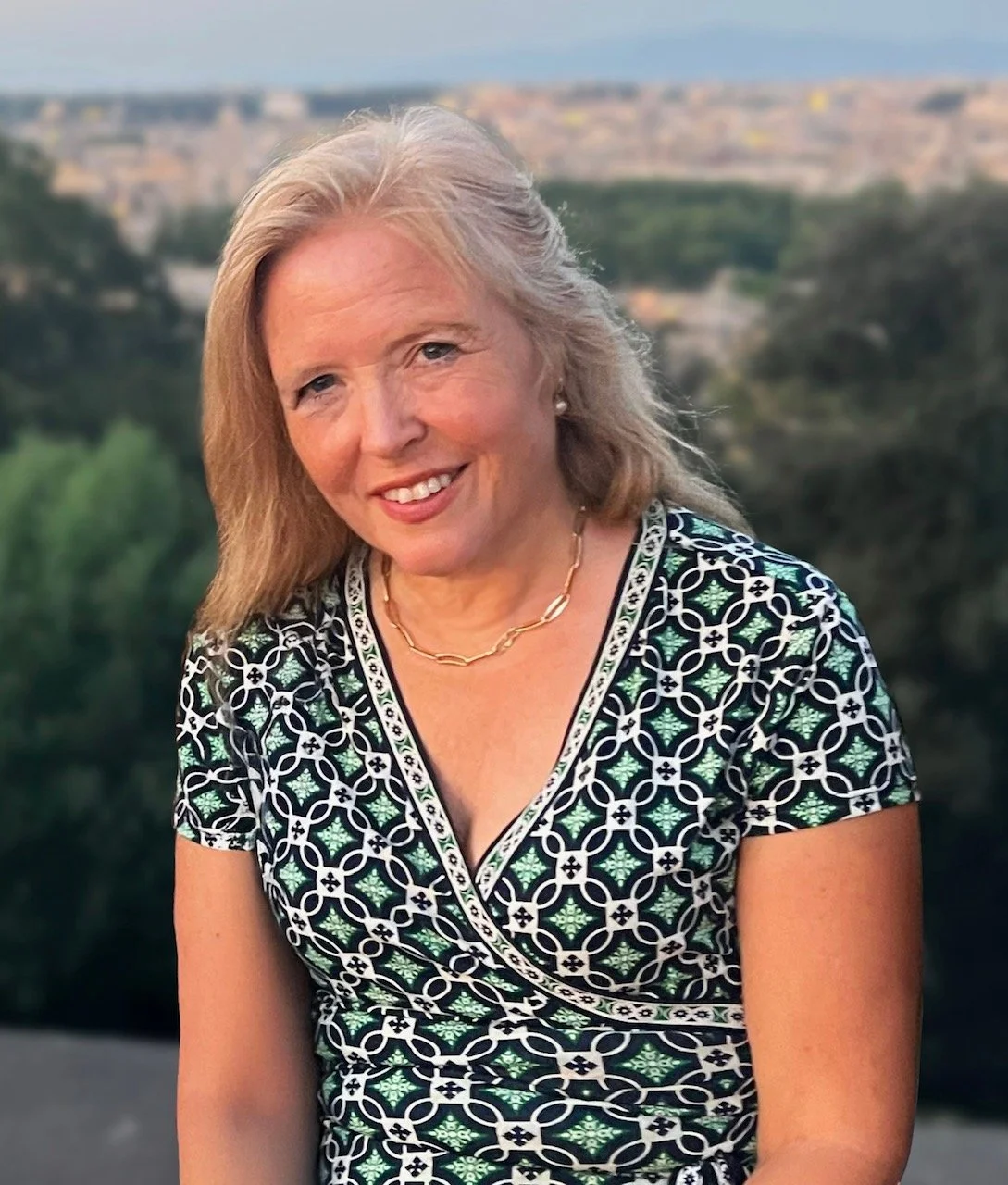
Elizabeth Anne Oman is a multidisciplinary writer and artist based in Washington D.C. Her work examines the mingled darkness and light of human character and the turbulent interaction of personalities, trying to understand the layered truth of what we feel and what we see. As a painter, Oman is fascinated by contrast, gesture and beauty, which translates to the sensual immediacy of people’s perceptions in her fiction. She holds a B.A. from Swarthmore and a Ph.D. from Berkeley, where her dissertation explored the ways in which a text invents and shapes its own ideal reader. Oman has taught both Literature and Women’s studies. She reads, writes, paints and spends hours outside every day. Her favorite thing is a vaguely organized road trip.